A young outfield player can have a quiet game and nobody notices. A young goalkeeper who lets in 25 goals is reminded of it every time the ball hits the net, in front of teammates, parents and the other team. Then comes the drive home.
Parents and youth coaches can make a real difference here, mostly in how they talk about the match and what they compare the goalkeeper with.
1. The car ride home
Researchers at the University of Toronto have looked at exactly this moment. In one study, Tamminen and colleagues interviewed 27 athletes aged 11 to 16 and their parents about the drive home after games and practices (Tamminen et al., 2017). The car turned out to be a private space where conversations could go both ways: helpful, or heated.
A later study filmed 28 parents and children on the way to and from their sport, 98 car rides in total (Tamminen et al., 2022). Most of the time was silence (59%). Sport took up only 12.9% of the time. Parents praised their child's performance more than the children did themselves. They asked mostly closed questions, rarely open ones, and sometimes answered before the child had a chance to.
From those studies, a few things are worth trying:
- Let it cool down first. Parents in the study found it valuable to give the emotions some time before talking about the match.
- Ask what they want to talk about. Some children want to go through the game, others want to talk about anything else. Both are fine.
- Ask open questions, like "What did you think about the second half?", and then wait for the answer.
- Start with something positive. One athlete in the study asked their parent to do exactly that, rather than always starting with the negative.
2. Compare with the right thing
It is easy to compare a 14-year-old with the numbers you hear from the national team. That isn't fair. Youth goalkeepers face different shooters, play shorter matches (2 × 25 minutes for ages 12 to 16 under the IHF rules) and are still learning the basics.
The comparison that means the most is the goalkeeper against themselves. Are they saving more from 9 meters than in the autumn? Are fewer goals going in low? Our guide to tracking a goalkeeper's development over a season goes through how to set a starting point and follow it.
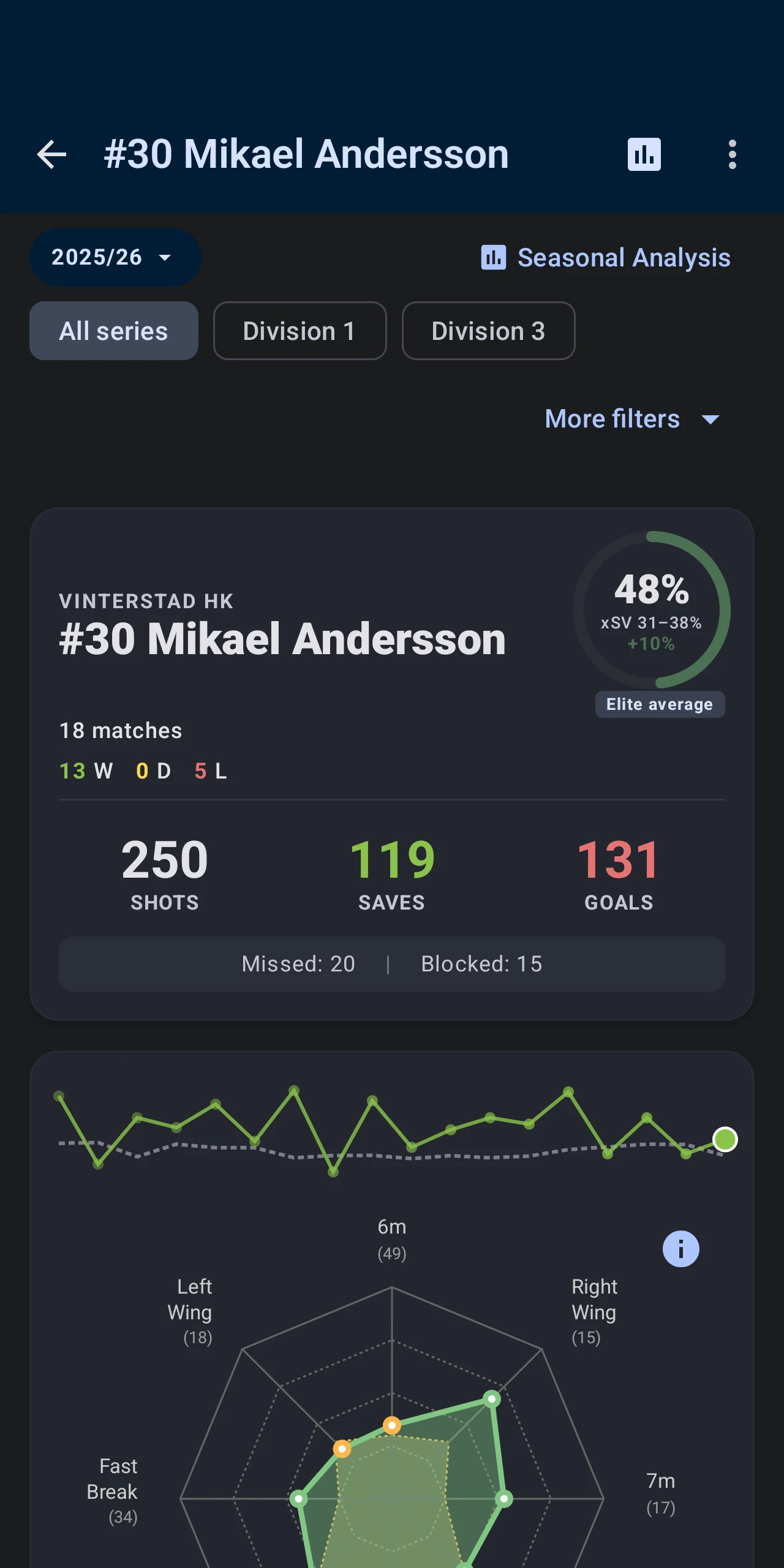
In Handball GoalieAnalytics, the expected saves (xSV) are based on elite matches by default. From Starter and up, you can switch the reference to the goalkeeper's own season average. Then the question isn't "Is my child as good as the national team?" but "Did my child play better than they usually do?"
3. Don't make it all about the goals
A lot of goals against a young goalkeeper come from chances the defense gave away: breakthroughs, free wing shots, fast breaks after turnovers. Those are hard to save at any level. Showing the goalkeeper where the shots came from is not making excuses. It is a fairer picture, and we explain why in why a strong defense matters for your goalkeeper.
4. Two strengths and one thing to work on
A simple structure we like for the talk after a match: name two things that went well, and pick one thing to work on. Not five. One clear focus for a few weeks is easier to train, and the goalkeeper doesn't leave the conversation feeling that everything went wrong.
"You were brilliant on the 9-meter shots, and you stayed calm on the penalties. Let's work on getting down faster on low shots."
5. Help from the stands
Parents are often the ones who have time to log shots during a youth match. In the app, a shot takes a couple of seconds to log, so it is possible to follow the match and do it at the same time. Our guide to keeping handball stats on your phone covers what to log and how to get started.
6. Celebrate progress
Progress for a young goalkeeper is easy to miss when you are in the middle of a season. Make it visible:
- Match report image and stories: On every plan, you can save the match report as an image or share it to stories. A good match is worth remembering.
- A link for family (Starter and up): Share the finished match as a web page. Grandparents and relatives can open it in any browser, also on an iPhone. The link works for 48 hours.
- Live link (Pro): Family who can't be in the hall can follow the match live.
Curious what it looks like? Our demo team shows two goalkeepers' season, with no sign-in needed.
Checklist
- Give it some time before talking about the match, and ask what your child wants to talk about.
- Ask open questions and listen to the answer.
- Compare the goalkeeper with themselves, not with the national team.
- Look at where the goals came from before judging the goalkeeper.
- Name two strengths and pick one thing to work on.
- Celebrate progress and share the good matches.
References & Scientific Sources
- Tamminen, K. A., Poucher, Z. A., & Povilaitis, V. (2017). The car ride home: An interpretive examination of parent–athlete sport conversations. Sport, Exercise, and Performance Psychology, 6(4), 325–339. doi:10.1037/spy0000093
- Tamminen, K. A., Bissett, J. E., Azimi, S., & Kim, J. (2022). Parent and child car-ride interactions before and after sport competitions and practices: Video analysis of verbal and non-verbal communication. Psychology of Sport and Exercise, 58, 102095. doi:10.1016/j.psychsport.2021.102095
- Iancovich, V. (2017, October 4). After the game: How parents can improve the car ride home with young athletes. University of Toronto News. utoronto.ca
- International Handball Federation. Rules of the Game, Rule 2:1 (playing time), here from the Swedish Handball Federation's translation: Svenska Handbollförbundet (2024). Handbollens spelregler 2024, kapitel 2. svenskhandboll.se