Imagine two handball goalkeepers finishing a match with the exact same stat line: 14 saves out of 40 shots (35.0% save rate). On paper, both goalkeepers had an identical evening.
Now picture the reality of those matches:
- Goalkeeper A played behind a granite 6-0 defense. 30 of the 40 shots faced were un-screened, long-range 9-meter shots over the defensive wall.
- Goalkeeper B played behind a chaotic defense. 25 of the 40 shots faced were point-blank 6-meter breakthroughs, wing 1-on-1s, and fast breaks.
Was their performance truly identical? Absolutely not. Goalkeeper A had a comfortable evening making routine saves. Goalkeeper B performed heroics just to keep their team in the game.
This fundamental flaw in traditional statistics is why top coaches and analysts rely on Expected Saves (xSV) and Goals Saved Above Expected (GSAE).
What is Expected Saves (xSV)?
Expected Saves (xSV) is an advanced analytical metric that calculates the statistical probability of any given shot being saved by an average benchmark goalkeeper.
Instead of treating every shot as a simple binary outcome (saved vs. scored), xSV assigns an expected save percentage between 0% and 100% to every shot based on location, shot type, and historical save data.
How Shot Difficulty is Weighted in Handball
In handball, shot difficulty varies dramatically depending on court positioning and execution. Biomechanical studies published in the European Journal of Sport Science show that shooter release angle and defensive block proximity account for up to 72% of save rate variance across competitive matches.
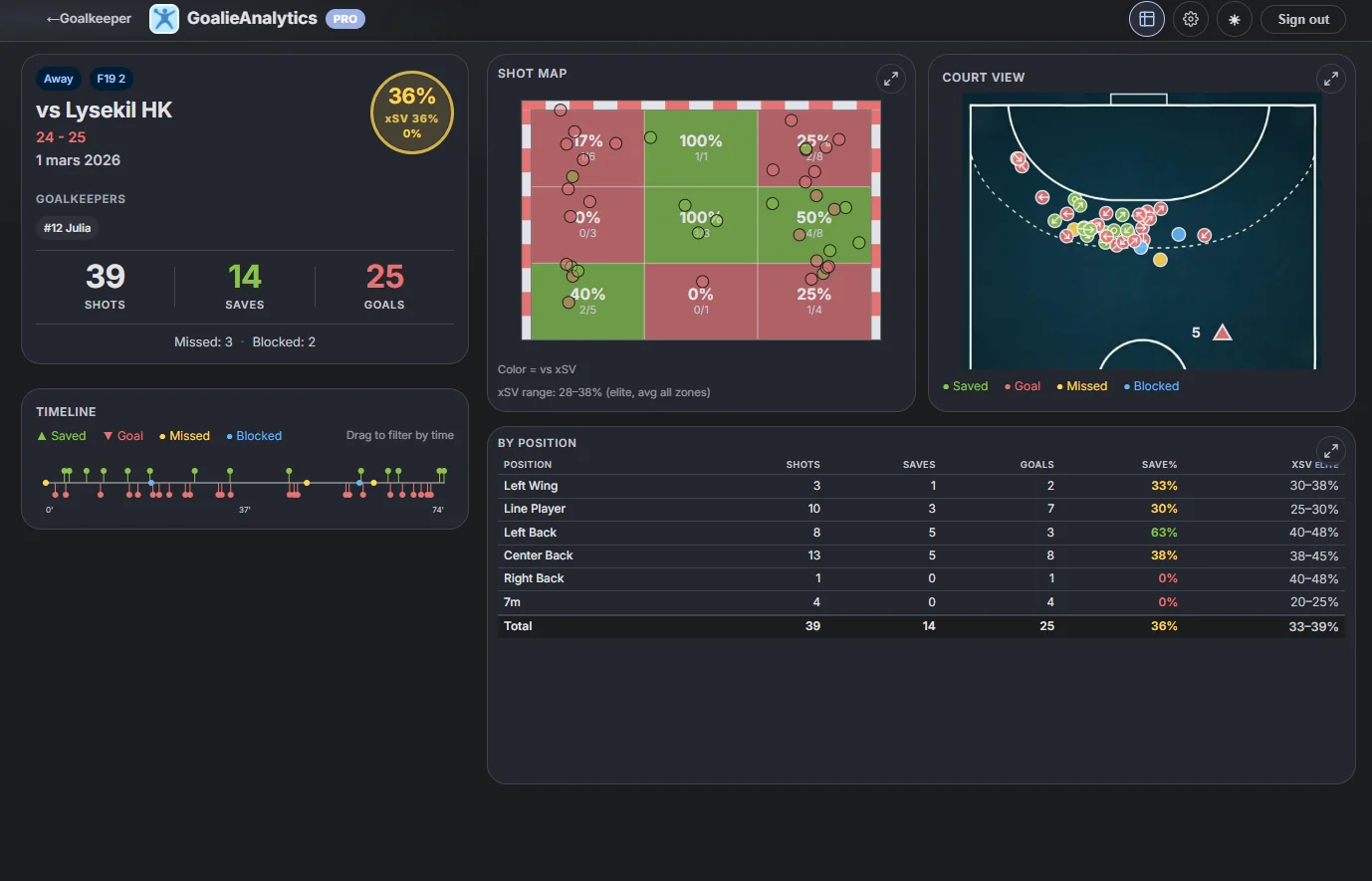
xSV models assign save probabilities based on key shot categories:
- 9-Meter Backcourt Shots (High xSV ~ 40% – 50%): Long-distance shots with a set defensive block give goalkeepers reaction time. Expected save probability is relatively high.
- Wing Shots (Moderate xSV ~ 28% – 38%): Sharp angles limit shooter options, but close proximity requires excellent timing and angle coverage.
- 6-Meter Pivot & Breakthroughs (Low xSV ~ 15% – 22%): Point-blank 1-on-1 duels where shooters have momentum and full choice of corner. Expected save probability is low.
- 7-Meter Penalty Throws (Low xSV ~ 18% – 24%): Pure static reaction and shooter habit reading.
- Fast Breaks (Very Low xSV ~ 12% – 18%): Maximum shooter velocity and choice. A save here is a massive positive outlier.
Measuring True Impact: Goals Saved Above Expected (GSAE)
While xSV tells you how many saves a goalkeeper should have made, Goals Saved Above Expected (GSAE) measures how much value the goalkeeper actually added to the team.
GSAE = Actual Saves - Total Expected Saves (xSV)
Example Scenario:
Suppose a goalkeeper faces 35 shots in a match. Based on the shot zones and difficulty breakdown, the cumulative xSV calculates that an average goalkeeper would make 10.5 saves.
- If your goalkeeper makes 14 saves: Their GSAE is
14 - 10.5 = +3.5. They saved 3.5 goals more than expected! - If your goalkeeper makes 8 saves: Their GSAE is
8 - 10.5 = -2.5. They underperformed expected benchmark by 2.5 goals.
3 Reasons Goalkeeper Coaches Need xSV
1. Fair Evaluation Across Different Defensive Systems
If your team plays an aggressive 3-2-1 defense that forces turnovers but occasionally concedes clear 6m breakthroughs, your goalkeeper's raw save percentage will naturally drop. xSV accounts for this, ensuring your goalkeeper isn't blamed for high-danger defensive lapses.
2. Protecting Goalkeeper Confidence
Young goalkeepers often judge themselves harshly after conceding 30+ goals in a game. Showing them that they faced an expected save total of only 8 saves, but made 11 (GSAE +3.0), proves they actually played a great game despite the scoreline.
3. Identifying Clutch Performances in Big Games
Raw save percentage can be padded during easy blowout wins against weak opposition. GSAE highlights who steps up when the quality of opponent shots is at its highest.
How Handball GoalieAnalytics Calculates xSV Automatically
Calculating expected saves manually after a match requires complex spreadsheet formulas.
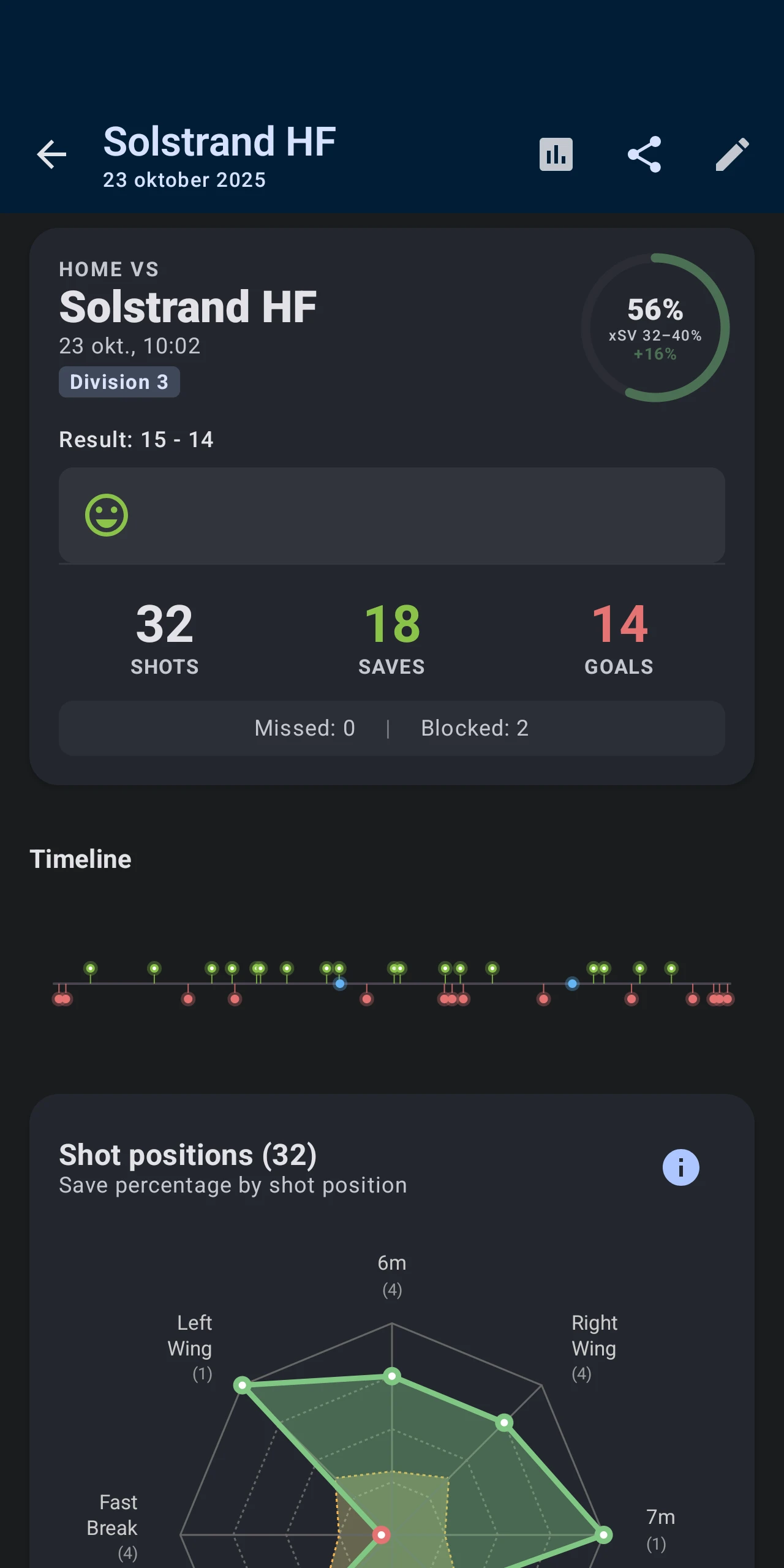
Handball GoalieAnalytics automates this entire process:
- As you tap shot origins and placement live on your phone or tablet, the app calculates xSV in real time.
- Your dashboard instantly displays GSAE, Zone Save Percentages, and Expected vs. Actual Save Radar Charts.
- You can export clean PDF reports to review during video sessions with your goalkeeper team.
Summary Takeaway
Raw save percentage tells you what happened. Expected Saves (xSV) tells you how well your goalkeeper played relative to the difficulty of shots faced.
By adopting xSV in your coaching workflow, you gain a fairer, more accurate, and far more motivating way to develop handball goalkeepers.
References & Scientific Sources
- European Journal of Sport Science: Biomechanical and spatial determinants of handball shooting success and goalkeeper save efficiency. (2019).
- International Journal of Performance Analysis in Sport: Quantifying expected shot values and goalkeeper performance in elite indoor sports. (2022).
- EHF Periodical for Coaches and Lecturers: Statistical Modeling of Goalkeeping Efficiency and Shot Probability in Elite Handball. (2021).