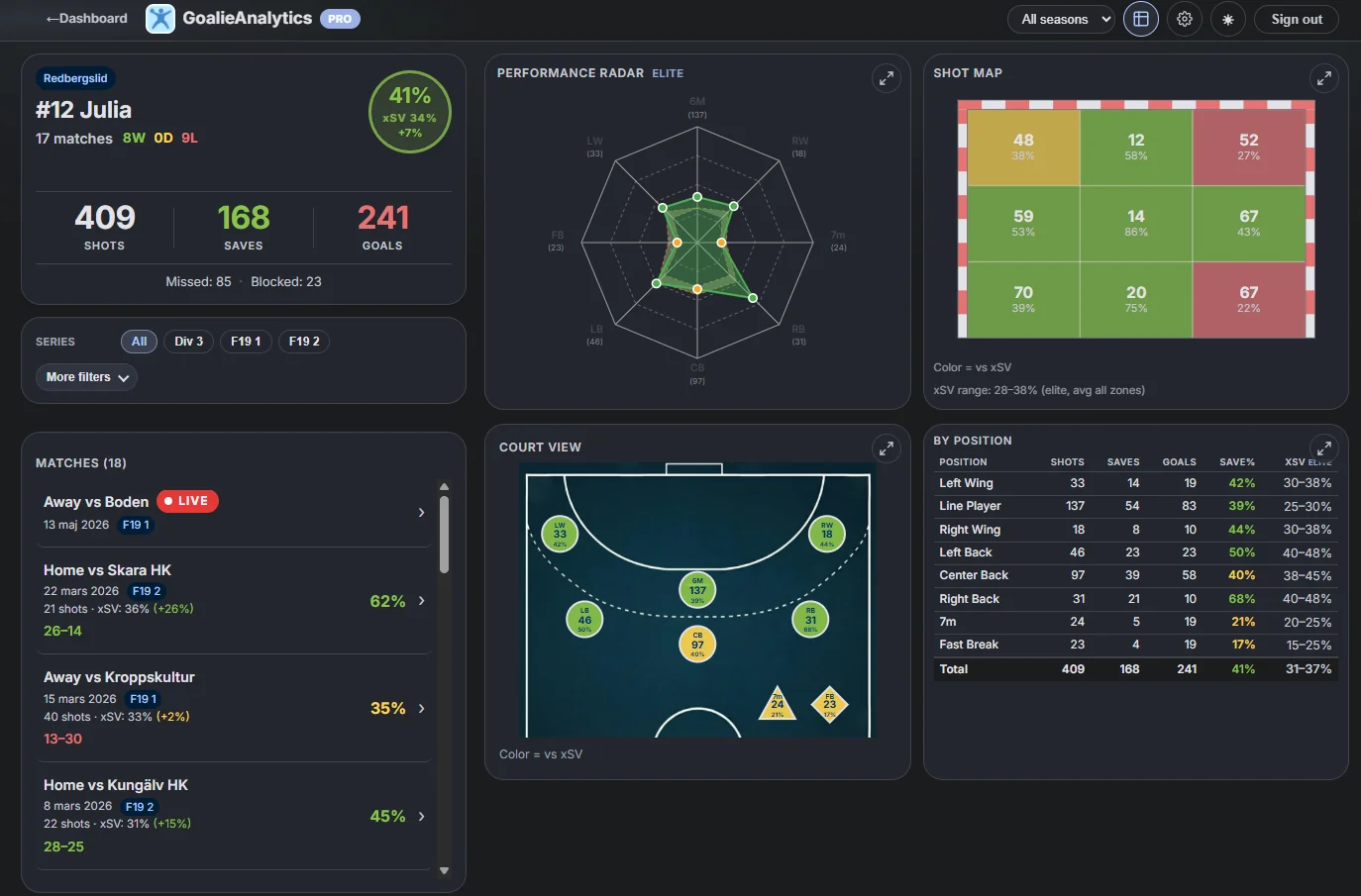
For decades, handball goalkeeper performance has been boiled down to a single metric: raw save percentage. If a goalkeeper saves 15 out of 45 shots, they finish the match at 33.3%.
While save percentage is a handy summary stat, any experienced goalkeeper coach knows it tells only a fraction of the story. A 30% save rate against un-screened 9-meter shots is poor. But a 30% save rate against 6-meter breakthroughs and 1-on-1 fast breaks? That is match-winning.
If you want to help goalkeepers improve—or if you are a goalkeeper wanting to understand your own game—you need to move beyond basic tallies. Here is a practical framework for tracking and analyzing handball goalkeeper performance effectively.
1. Break down save percentage by shot zone
The first step in modern goalkeeper analytics is contextualizing where shots originate. A save against a tight-angle wing shot requires completely different positioning, body shape, and timing than reacting to a central 9-meter jump shot.
Sports science research published in the Journal of Sports Sciences reveals that elite handball jump shots reach speeds exceeding 100 km/h (62 mph). At this velocity, goalkeepers have less than 320 milliseconds to react. From 6 meters, pure reaction is humanly impossible—making positional reading and zone anticipation responsible for over 60% of successful saves.
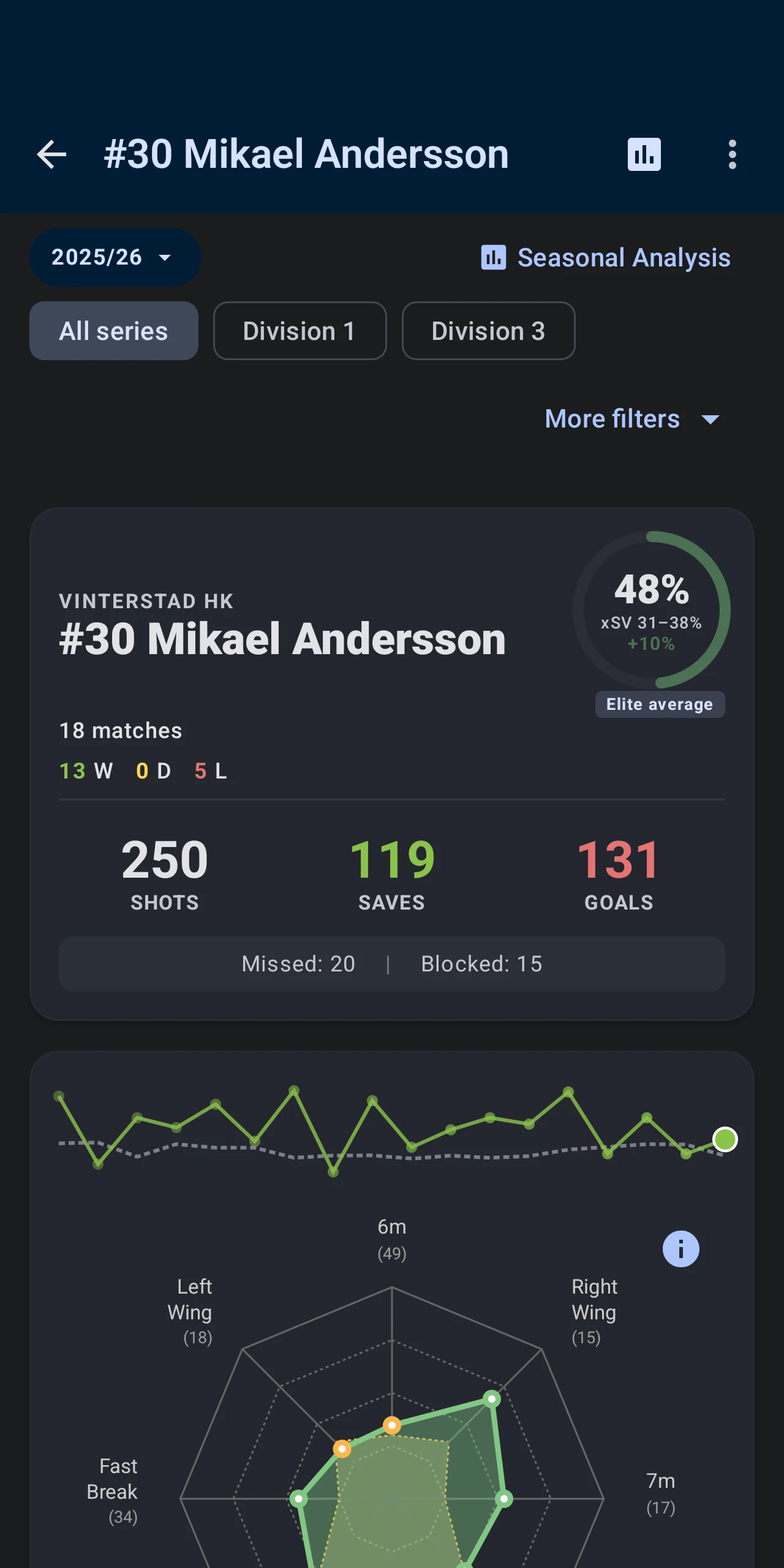
When tracking matches, group shots into five core zones:
- 9-Meter (Backcourt): Distance shots over or through the defensive block. Save expectations here are typically highest (35%–45%+).
- Wing Shots (Left & Right): Sharp angle shots where body positioning, closing angles, and patience matter most.
- 6-Meter / Breakthroughs: Close-range 1-on-1 duels through the center of the defense.
- 7-Meter Penalties: Pure psychological duels where shooter habit recognition and timing are decisive.
- Fast Breaks: High-velocity counter-attacks where shooters have full control and momentum.
2. Track shot placement inside the goal
Knowing where the shooter stands is only half the battle; knowing where the ball enters the goal frame is equally vital.
Mapping shot placement across a standard goal grid reveals key technical habits:
- Top corners (High left / High right): Tests explosive leg push, arm extension, and reaction speed.
- Mid-height shots: Tests lateral arm extension and hip mobility.
- Low shots & bounce shots: Tests sweep technique, quick leg drops, and footwork.
- Between the legs ("Five-hole"): Often indicates premature jumping or dropping into a split too early.
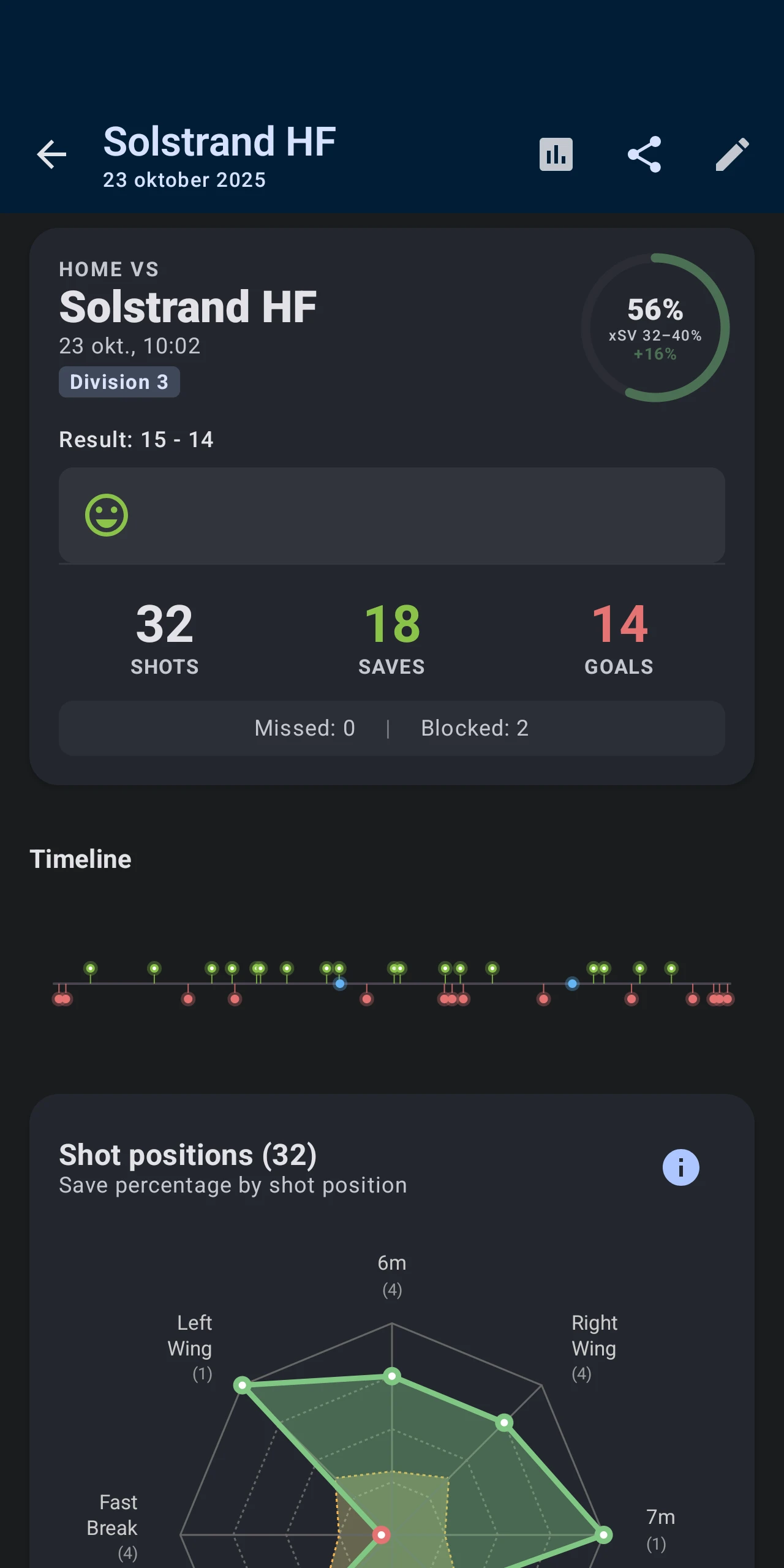
The Power of Placement Heatmaps
When you log shot placement over 5 to 10 matches, clear patterns emerge. You might discover that a goalkeeper consistently concedes low-corner bounce shots during the second half of matches—pointing toward fatigue or incorrect footwork when dropping low under pressure.
3. Use Expected Saves (xSV) to measure real impact
In modern sports analytics—supported by match data models from the European Handball Federation (EHF)—Expected Saves (xSV) is becoming the gold standard for goalkeeper evaluation.
Not all shots carry the same difficulty. A point-blank pivot shot has a low expected save probability (around 15–20%), while a central 10-meter shot with a structured block has a much higher expected save probability (around 45–50%).
- Expected Saves (xSV): Measures how many saves an average goalkeeper would be expected to make based on the location and type of shots faced.
- Goals Saved Above Expected (GSAE): If a goalkeeper is expected to make 10 saves based on shot quality, but actually makes 14, they have saved +4 goals above expected.
xSV protects goalkeepers from being judged unfairly when playing behind a weak defense that concedes constant high-danger 6m shots. Conversely, it highlights when a goalkeeper is genuinely stealing points for their team.
4. Live match tracking vs. Post-game analysis
Data is most valuable when it can influence decisions when it matters most. There are two distinct phases to performance tracking:
In-Match (Live Tactical Tips)
During a game, bench staff or assistant coaches need a logging method that takes less than 2 seconds per shot. You cannot sit with a pen and notepad writing long paragraphs while the game moves at breakneck speed.
With rapid live tracking, you can spot tendencies during timeouts or at half-time:
"Their right wing shooter has taken four shots, and all four went low to your left corner."
Post-Match (Long-Term Development)
After the final whistle, aggregate match data into visual dashboards:
- Review save percentage trends over 5 to 10 matches.
- Compare home vs. away performance.
- Generate visual PDF summaries to review together during 1-on-1 video sessions.
5. Streamlining the process with digital tools
Historically, tracking handball stats required complex Excel spreadsheets or tedious post-game video coding. Dedicated tools make this workflow seamless.
Platforms like Handball GoalieAnalytics are built specifically for this workflow:
- Sub-2-second shot entry: Built for mobile devices so parents, assistant coaches, or bench staff can log shots live without missing the action.
- Automatic Radar Charts & Heatmaps: Instantly converts shot locations into visual breakdowns of goalkeeper strengths and improvement areas.
- Cloud Sync & PDF Reports: Shares match reports instantly with coaches and goalkeepers across devices.
Summary Checklist for Coaches and Goalkeepers
- Stop relying on raw save percentage alone. Always contextualize shot difficulty.
- Log shot origins: Categorize shots by 9m, 6m, Wing, 7m, and Fast Break.
- Track goal placement: Identify recurring weak zones in the goal frame.
- Evaluate via xSV: Measure performance relative to expected save probability.
- Keep live logging fast: Use quick-input tools during games, and save detailed reviews for post-match analysis.
References & Scientific Sources
- Journal of Sports Sciences: Visual search strategies and decision-making in elite handball goalkeepers facing jump shots. (2018).
- European Handball Federation (EHF) Scientific Network: Match Performance Analysis and Goalkeeper Efficiency in European Championship Tournaments. (2021).
- International Journal of Computer Science in Sport: Positional Shot Probability Models and Goalkeeper Performance Metrics in Team Handball. (2020).