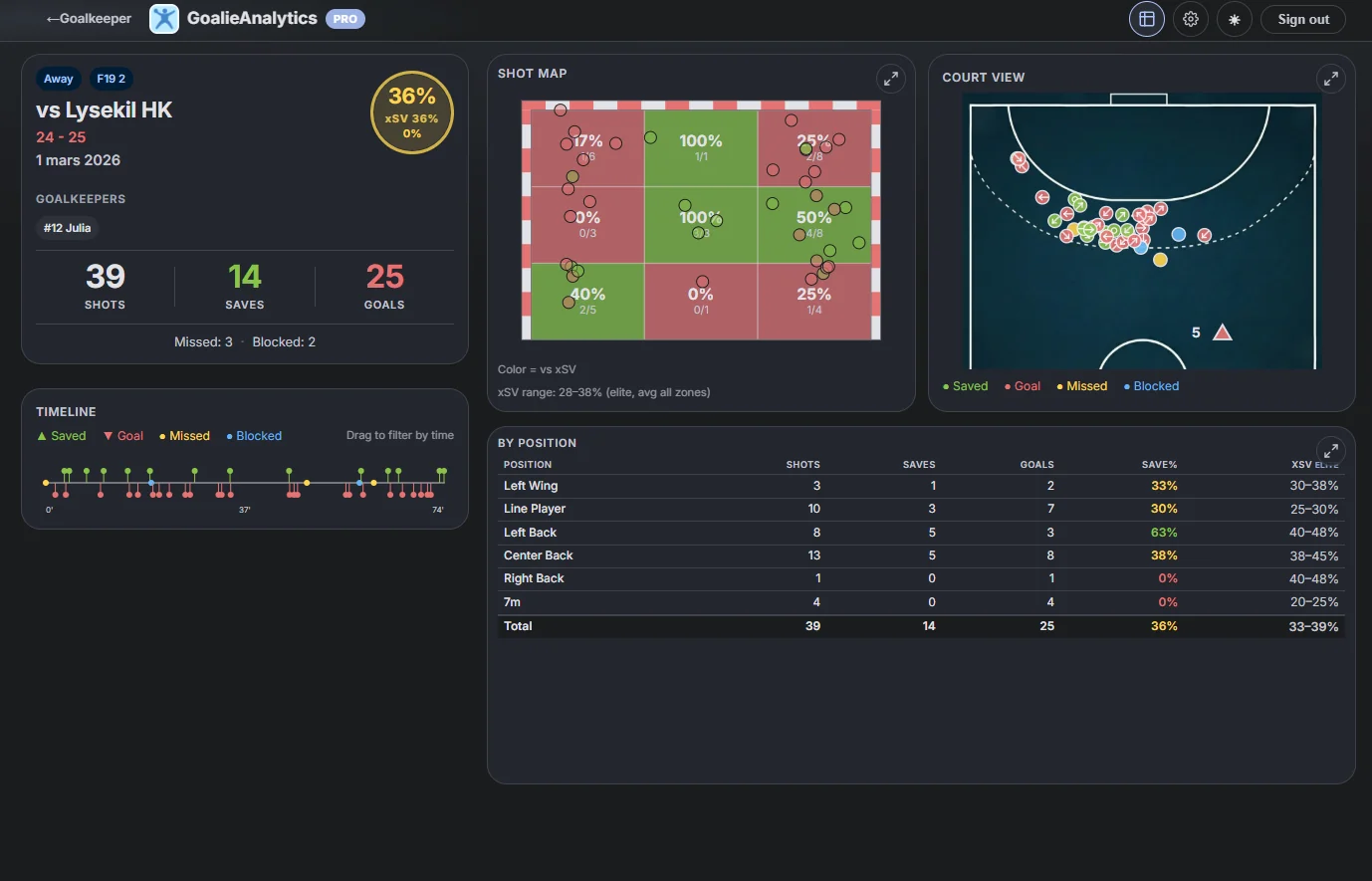
Every goalkeeper has had that match. Breakthroughs straight through the middle, the pivot turning free again and again, wings shooting from wherever they liked. You end up on 25%, and somehow that number goes in the goalkeeper's column.
It works the other way too. The defense steps out, takes the shooter's arm away, blocks a couple of shots, and the goalkeeper finishes on 45% and gets all the praise. In both cases a fair share of the number belongs to the six players in front of the goal.
That doesn't make the goalkeeper's own work less important. But if you want to judge a goalkeeper fairly, or help them improve, you need to know what the defense did in front of them.
1. The defense decides which shots the goalkeeper gets
Not all shots are equally hard to save. At the 2017 Women's World Championship, goalkeepers saved about 44% of 9-meter shots, around 22% of fast breaks and only 16% of breakthroughs (Gómez-López et al., 2020).
So when the defense holds and the opponent has to shoot from distance, the goalkeeper gets shots they have a real chance against. When the defense opens up, the shots come from 6 meters with nobody in the way, and even a very good goalkeeper will let most of them in.
2. A good defense makes the shot easier to read
The shots a goalkeeper faces are rarely one against one. Prudente, Garganta and Anguera (2010) point out that in more than half of all shots there is a defender between the ball and the goal, or the shooter is under pressure from defenders. Studying goalkeepers and defenders in high-level matches, they found that the goalkeeper's performance was clearly linked to what the defenders did.
Their explanation makes sense to anyone who has stood in goal. When defenders step out and put pressure on the shooter, the shooter has fewer options. Fewer options means the goalkeeper can read the shot earlier. A Polish study of 1,739 backcourt shots in the top league found something similar: how well goalkeepers saved depended on whether the shot went over the block and whether the shooter had contact with a defender (Krawczyk et al., 2020).
This is also why the goalkeeper and the block need to agree on who takes what. If the block covers the long corner, the goalkeeper takes the short one.
3. How to see a strong defense in the statistics
In Handball GoalieAnalytics, every shot is logged as a save, a goal, a miss or a block. Shots that miss the goal or get blocked are not part of the save percentage. The goalkeeper isn't credited for them, and isn't punished for them either. But they say a lot about the defense.
Three things are worth looking at after a match:
- Shots on goal. The fewer shots that reach the goalkeeper, the more attacks the defense stopped before they turned into a shot: steals, offensive fouls, passive play. Compare with the season average shots per match, which is shown under the match statistics.
- Blocks. Every block is a shot the defense took away. A few blocks per match means the defense is stepping up against the backcourt shooters.
- Misses. Shooters under pressure miss more often. Be a bit careful here, though. Some misses are just bad shots, and a goalkeeper who closes the angle well forces misses too. Look at misses over several matches rather than one.
What is a normal number? At the 2015 men's World Championship there were 6,893 shots on goal in 88 matches (Hansen et al., 2017). That works out to about 39 per team and match. Club and youth matches usually see fewer, with shorter games in the younger age groups and a lower tempo, so the goalkeeper's own season average is a better yardstick than the World Championship figure.
Then look at where the shots came from. The shot positions show how many shots came from 9 meters, the wings and the pivot. Lots of pivot shots and few 9-meter shots usually means the defense was opened up in the middle. Lots of 9-meter shots means it held.
One thing that matters a lot: log every attempt, also the blocked shots and the ones that go wide. If only shots on goal get logged, there is nothing to say about the defense afterwards.
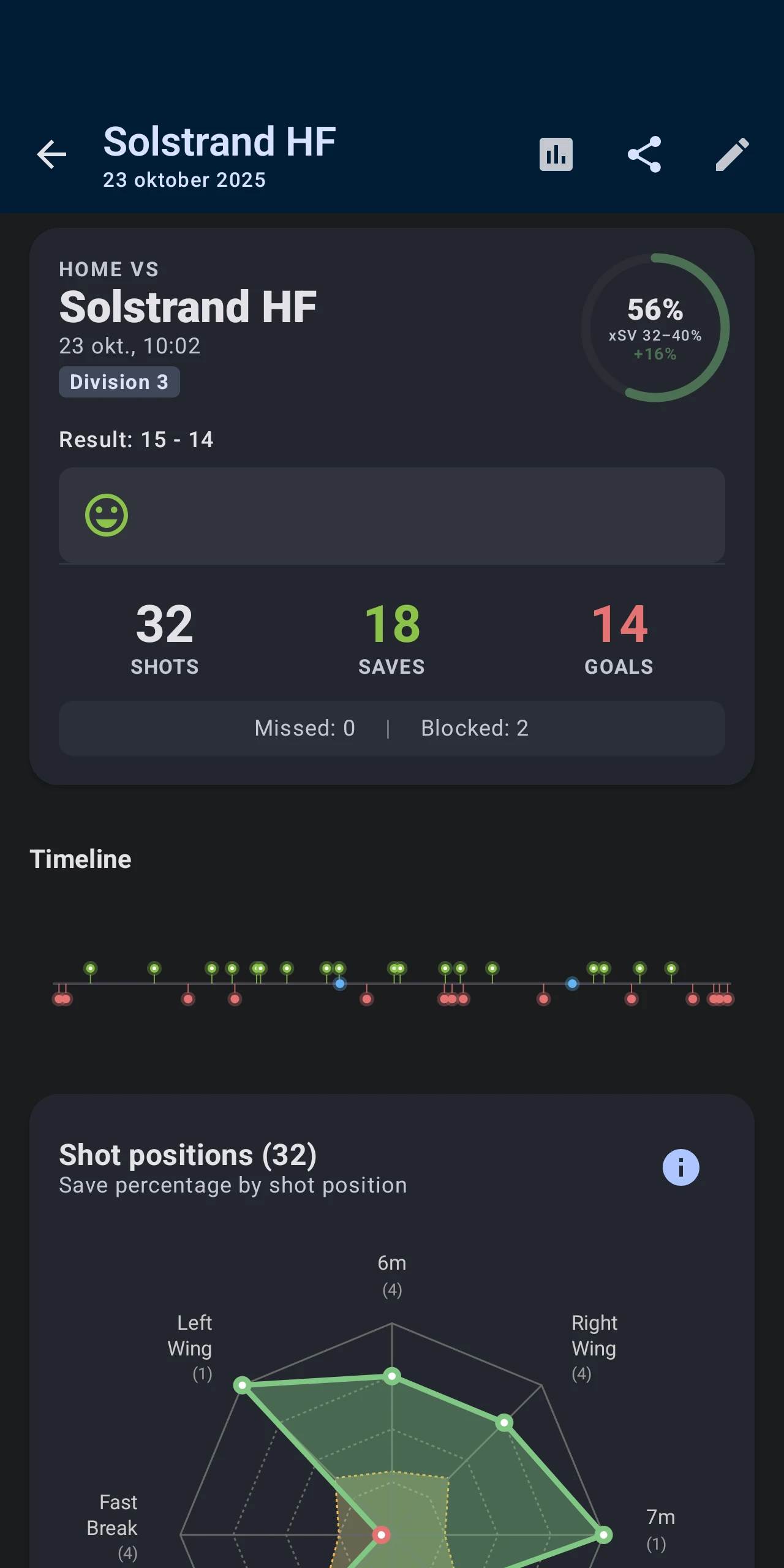
This match from our demo team shows what it looks like: 37 shots on goal, plus 8 missed and 7 blocked. The goalkeeper saved 32%, within the expected range of 32–38% for those shots.
4. Separate the goalkeeper from the defense with expected saves
Expected saves (xSV) take into account where the shots came from and what kind of shots they were. A match full of 6-meter shots gives a low xSV, and a match full of 9-meter shots gives a high one. The goalkeeper is then compared against that, not against a fixed number.
That works in both directions. A goalkeeper on 30% behind a defense that gave up chance after chance can still be above expected and have played a good match. And a goalkeeper on 45% behind a defense that only let in 9-meter shots may just be doing what is expected.
"You were at 31%, but you were five saves above expected. Most of their goals came from the pivot. That's on us, not on you."
5. Talk about it as a team
Goals conceded are a team thing, and the statistics make that easier to show, also during the match. When you go through a match, do it with the defenders too, not just the goalkeeper:
- Where did the shots come from, and could we have pushed them further out?
- How many shots did we block, and how many reached the goalkeeper?
- Did the block and the goalkeeper agree on which corner each of them was taking?
For youth teams this matters even more. Young goalkeepers often take every goal personally. Showing them that a lot of the goals came from chances the defense let through is not an excuse. It's simply a fairer picture of what happened.
Checklist
- Remember that the defense decides which shots the goalkeeper faces.
- Log every attempt, including misses and blocked shots.
- Look at shots on goal, blocks and misses together, and compare with the season average.
- Check where the shots came from. Many pivot shots and breakthroughs point to the defense.
- Use expected saves to separate the goalkeeper's work from the defense's.
- Go through goals conceded with the whole defense, not only the goalkeeper.
References & Scientific Sources
- Gómez-López, M., Angosto, S., & Antúnez, A. (2020). Efficiency of the goalkeepers in the women's World Handball Championship in Germany 2017. Revista Brasileira de Cineantropometria & Desempenho Humano, 22, e72115. doi:10.1590/1980-0037.2020v22e72115
- Hansen, C., Sanz-Lopez, F., Whiteley, R., Popovic, N., Ahmed, H. A., & Cardinale, M. (2017). Performance analysis of male handball goalkeepers at the World Handball Championship 2015. Biology of Sport, 34(4), 393–400. doi:10.5114/biolsport.2017.69828
- Prudente, J., Garganta, J., & Anguera, M. T. (2010). Methodological approach to evaluate interactive behaviors in team games: An example in handball. Proceedings of the 7th International Conference on Methods and Techniques in Behavioral Research (Measuring Behavior 2010). doi:10.1145/1931344.1931385
- Krawczyk, P., Cackowski, M., & Dziubek, L. (2020). The participation of the defender and the actions of handball goalkeepers in the situation of throws from backcourt positions. International Journal of Performance Analysis in Sport, 20(3), 445–455. doi:10.1080/24748668.2020.1753966