The half-time break in handball is normally 10 minutes (IHF Rules of the Game, rule 2:1). By the time the team has sat down, the coach has talked about the attack and the defense, there might be a minute or two left for the goalkeeper. That is not much time to get it right.
Going on feeling alone is risky. The goals you remember are the ones that stung, not necessarily the ones that tell you what is going on. Three numbers help you say something useful, and avoid taking off a goalkeeper who is actually doing fine.
1. Where did the goals come from?
Start by separating a goalkeeper problem from a defense problem. Shots from different positions are not equally hard to save. At the 2017 women's World Championship, goalkeepers saved about 44% of 9-meter shots, but only around 22% of fast breaks and 16% of breakthroughs (Gómez-López et al., 2020).
- Mostly 9-meter goals: These are the shots the goalkeeper has the best chance against. If they keep going in, it is worth talking to the goalkeeper about the block, positioning or reading the shooter.
- Mostly 6-meter, breakthrough and fast-break goals: The defense let the opponents get close, or lost the ball. That is a conversation for the whole team.
- Misses and blocked shots: These don't count against the goalkeeper, but they tell you whether the defense is putting the shooters under pressure.
We go deeper into this in why a strong defense matters for your goalkeeper.
2. When did the goals come?
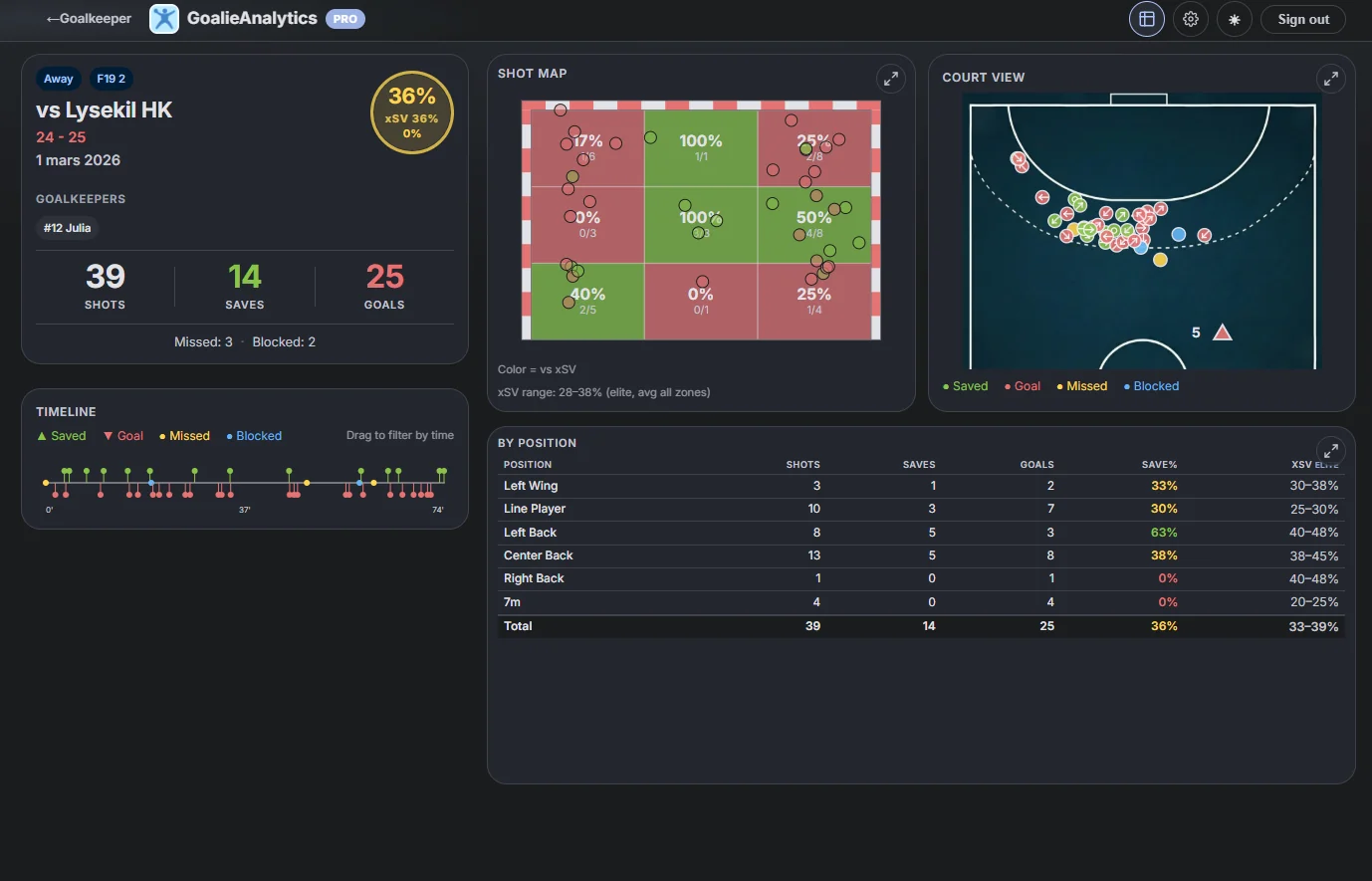
A goalkeeper on 25% after 30 minutes may have had one bad spell, not a bad half. Look at the timeline of the shots:
- Did the goals come in a run, for example while your team was a player down after a suspension?
- Was there a period where the goalkeeper saved well, and then something changed?
- How did the last ten minutes look compared with the first twenty?
A spell of goals during a suspension says more about the situation than about the goalkeeper. A slow drop over the whole half can point to something the goalkeeper needs to adjust, or simply to tiredness.
3. Saves compared with what was expected
Before you take a goalkeeper off, compare their saves with what the shots called for. 30% sounds poor. But if the opponents mostly scored from the pivot and on fast breaks, the expected save range might be 25–30%, and the goalkeeper is doing their job.
Our guide to Expected Saves (xSV) explains how the range is worked out. The point here is simple: a change of goalkeeper should be based on the goalkeeper's own play, not on a defense that is letting the shooters through.
"You're at 30%, but most of their goals came from 6 meters. You're right where you should be. Keep doing what you're doing, and we'll fix the middle of the defense."
What to say in the time you have
One or two concrete things are enough. A goalkeeper who gets a list of five things to think about usually remembers none of them.
- Something that works: "Your 9-meter saves are good. Keep trusting the block."
- One thing to adjust: "Their left wing has scored twice low at the near post."
Getting the numbers to the bench
None of this works if nobody is logging. The coach is busy coaching, so it works best with an assistant, a teammate who isn't playing or a parent in the stands logging the shots. In Handball GoalieAnalytics, a shot takes a couple of seconds to log on the phone, and the save percentage and expected saves update as you go.
- Live sharing (Pro): The person logging shares a link, and the coach follows the match live on their own phone or tablet, with shot positions, the goal map and the timeline.
- After the match (Starter and up): Share the finished match as a web page that the coach and the goalkeeper can open in any browser. The link works for 48 hours.
Want to see what a match looks like? Open a match in our demo team and try dragging across the timeline.
Checklist
- Check where the goals came from before you talk to the goalkeeper.
- Separate goals the goalkeeper could influence from chances the defense gave away.
- Look at when the goals came, not only how many.
- Compare saves with what was expected before making a change.
- Give the goalkeeper one or two concrete things, not a list.
- Decide who logs the shots before the match starts.
References & Scientific Sources
- International Handball Federation. Rules of the Game, Rule 2:1 (half-time break), here from the Swedish Handball Federation's translation: Svenska Handbollförbundet (2024). Handbollens spelregler 2024, kapitel 2. svenskhandboll.se
- Gómez-López, M., Angosto, S., & Antúnez, A. (2020). Efficiency of the goalkeepers in the women's World Handball Championship in Germany 2017. Revista Brasileira de Cineantropometria & Desempenho Humano, 22, e72115. doi:10.1590/1980-0037.2020v22e72115