A 7-meter throw is the loneliest moment in handball. Everyone in the hall stops, the shooter has all the time they want, and the goalkeeper knows exactly where the ball is coming from. And most of the time it still goes in.
That is not a reason to give up on penalties. It is a reason to judge them fairly, and to prepare for them the way the shooters do: with information.
1. What the numbers say
The shooter wins this duel far more often than the goalkeeper. Laxdal et al. (2024) went through 33,856 7-meter shots from the Danish and Norwegian elite divisions between 2015 and 2023. 77% of them were scored. At 41 major championships over the same period, the figure was the same: 77% of 16,398 shots.
The World Championships point the same way. At the 2015 men's World Championship, 515 of 697 7-meter throws were scored, 74% (Hansen et al., 2017). At the 2017 women's World Championship, goalkeepers saved 19.1% of them (Gómez-López et al., 2020).
The same study also checked a common idea: that left-handed penalty takers are harder to save. They weren't. Left-handers scored about as often as right-handers, in the leagues and at the championships (Laxdal et al., 2024). So prepare for the shooter in front of you, not for which hand they throw with.
2. Judge penalties separately
Because so many penalties go in, they drag down a save percentage in a way that says little about the goalkeeper. Three penalties conceded in a match is three goals against, but it is also what you would expect.
That is why it helps to look at 7-meter throws on their own, and to compare saves against what the shots called for. Our guide to Expected Saves (xSV) explains how. A goalkeeper who faced six penalties and saved two was above expected on those shots, even if the match report says 33%.
3. Log every penalty the same way
You can't prepare for a shooter you know nothing about. The good news is that a penalty is easy to log, because the situation is the same every time. Four things are enough:
- That it was a 7-meter throw. So penalties can be separated from shots in open play.
- Where it went in the goal. High, mid or low, and which side.
- What happened. Goal, save or miss.
- Who took it. The shooter's jersey number.
4. Build your own notes on the shooters
Over a match or two, patterns can start to show. Maybe their number 7 has taken three penalties and all three went low. That is the kind of note a goalkeeper can use the next time the same player steps up.
Be careful not to read too much into a handful of throws. Three penalties is a hint, not a law, and good penalty takers change their shot when they notice the goalkeeper has figured them out. Use the notes to decide where to start, not as a guarantee.
Jersey numbers only mean something within the same opponent. Number 7 in one team is not number 7 in the next, so look at the matches against that team when you prepare.
How it works in the app
- Turn on Register shooters when you start the match. You then add the shooter's number when you log a shot.
- In the match summary you can filter by shooter, both during the match and afterwards.
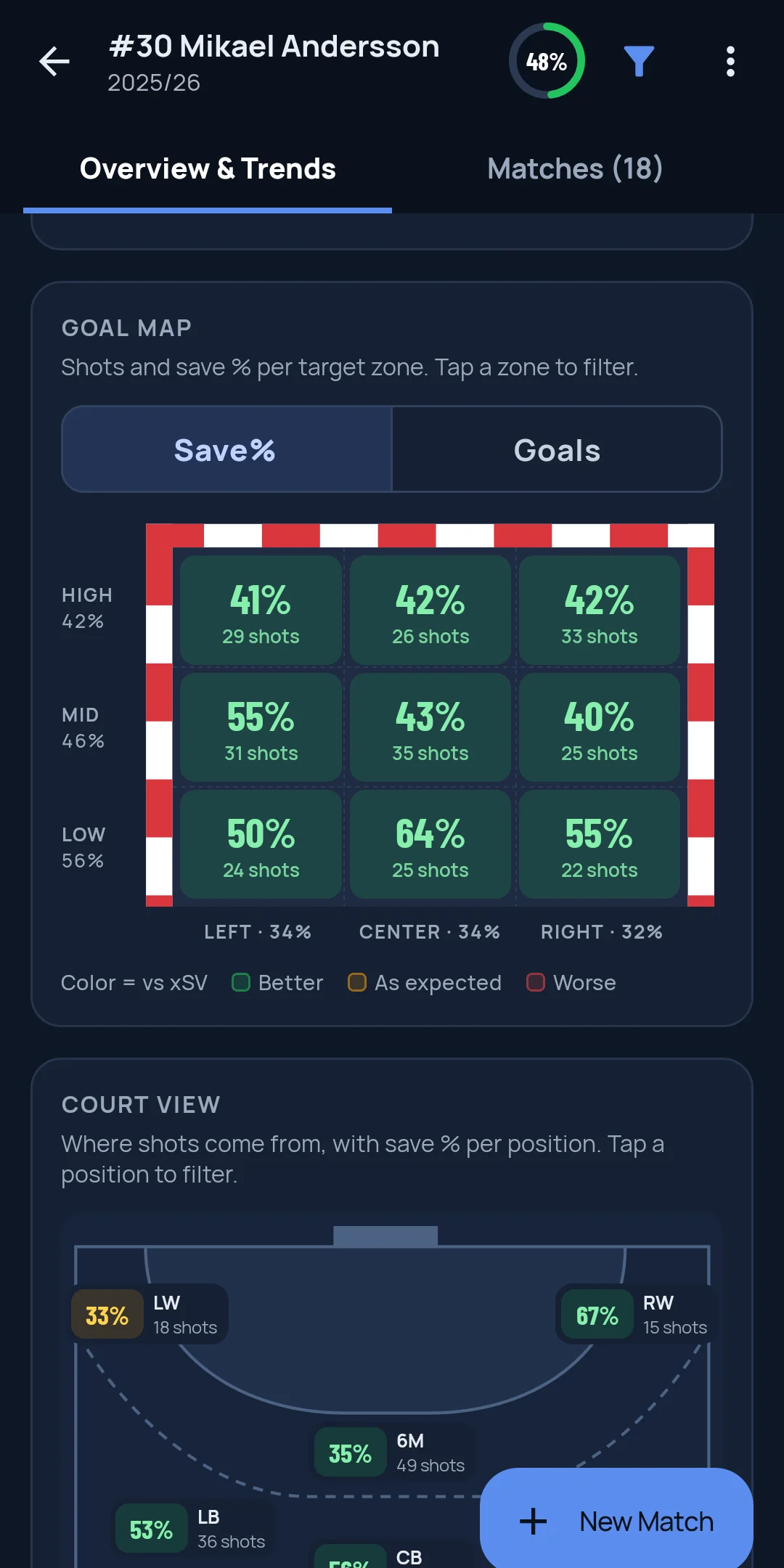
- In the web dashboard (Plus and Pro), the Shooter # filter and the court view work on the goalkeeper's whole season. Tap 7M to see only penalties.
You can try the court view and the goal map in our demo team, without signing in.
5. Talk about penalties after the match
Goalkeepers often remember penalties as failures, because most of them go in. Going through them with the numbers in front of you changes the tone:
"You faced five penalties and saved one. That's normal. But four of the five went low to your left. Let's look at that this week."
That keeps the focus on something the goalkeeper can actually work on, instead of on the goals they could hardly have stopped.
Checklist
- Expect most penalties to go in. Saving one in four or five is par at the top level.
- Look at 7-meter throws separately from shots in open play.
- Log every penalty: that it was a 7-meter throw, where it went, what happened and who took it.
- Build notes per shooter, but treat a few throws as a hint, not a rule.
- Compare shooters only within the same opponent.
- Go through penalties calmly after the match and pick one thing to work on.
References & Scientific Sources
- Laxdal, A., Haugen, T., Angeltveit, Ø., Sørensen, C., & Ivarsson, A. (2024). Is left-handedness associated with greater success from the 7-meter line? An analysis of 7-meter records across various handball competitions. Perceptual and Motor Skills, 131(5), 1743–1754. doi:10.1177/00315125241272503
- Hansen, C., Sanz-Lopez, F., Whiteley, R., Popovic, N., Ahmed, H. A., & Cardinale, M. (2017). Performance analysis of male handball goalkeepers at the World Handball Championship 2015. Biology of Sport, 34(4), 393–400. doi:10.5114/biolsport.2017.69828
- Gómez-López, M., Angosto, S., & Antúnez, A. (2020). Efficiency of the goalkeepers in the women's World Handball Championship in Germany 2017. Revista Brasileira de Cineantropometria & Desempenho Humano, 22, e72115. doi:10.1590/1980-0037.2020v22e72115